

Living Inside UX: The World as a Design System
For me, a strong UX design philosophy is never something you simply clock into at the start of a workday. It is the permanent lens through which I experience, process, and navigate the world around me.
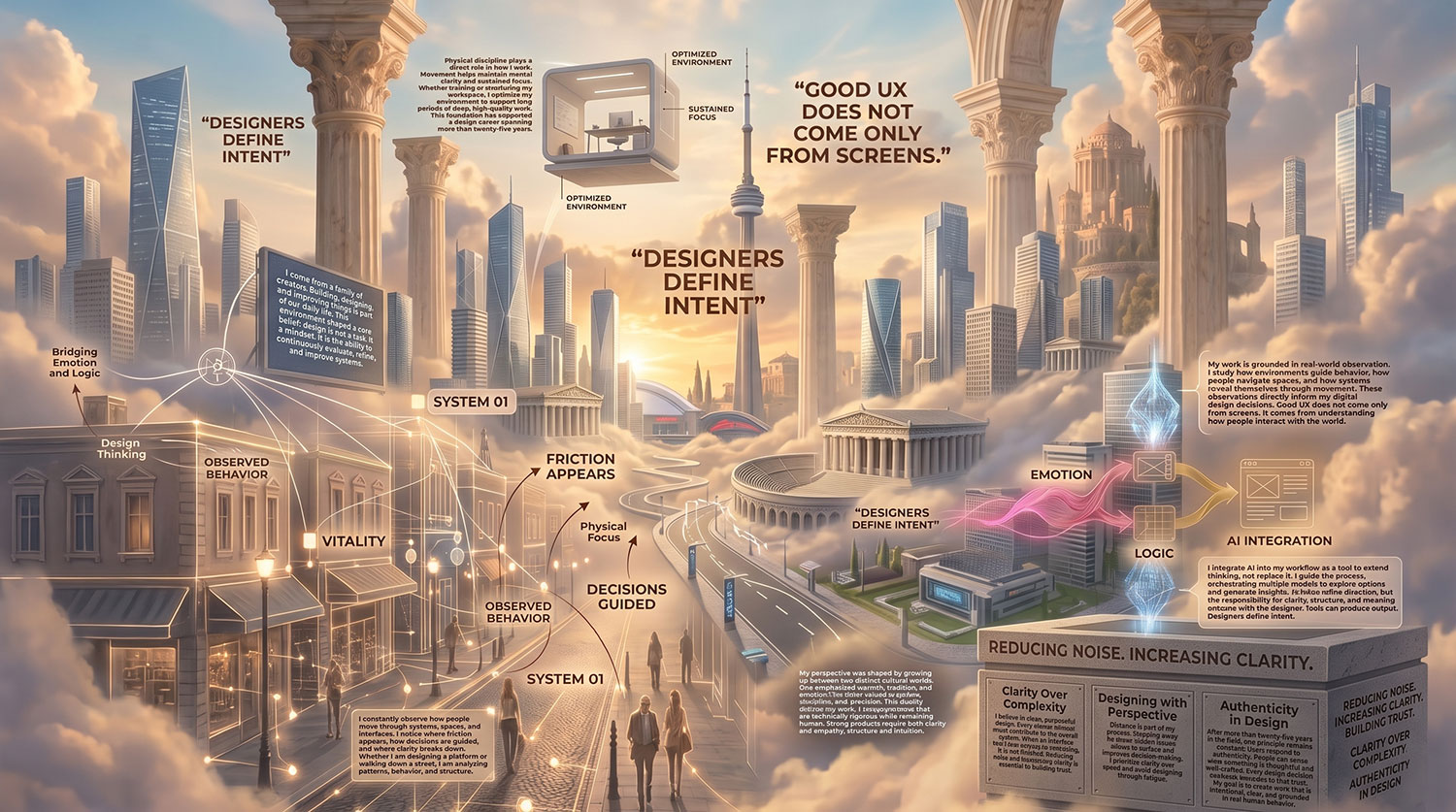
I find myself quietly observing how people move through physical spaces, navigate complex systems, and interact with screens. I notice the exact moment friction appears, how subtle cues guide human decisions, and where clarity inevitably breaks down. Whether I am architecting a digital platform or just walking down a bustling street, my mind is always analyzing behavioral patterns, spatial flow, and structural clarity. This constant observation fuels my daily work and keeps my perspective rooted entirely in reality.
Bridging Emotion and Logic
My professional perspective was deeply shaped by growing up between two distinct cultural worlds. One side of my family emphasized warmth, vibrant tradition, and deep emotion, while the other valued rigorous structure, quiet discipline, and absolute precision.
This duality beautifully defines my daily work. I strive to architect systems that are technically rigorous while remaining unmistakably human. The most exceptional digital products require both analytical clarity and profound intuitive empathy. Without empathy, a system is just cold logic. Without structure, empathy cannot scale.
Design as a Way of Thinking
Coming from a family of makers and creators, the drive to build, design, and improve has always been woven into the fabric of my everyday life. It was never a forced skill; it was a natural instinct to look at a process and ask how it could be made smoother.
This foundational environment instilled a permanent belief in me. Design is never just a task list or a set of deliverables. It is an active, living mindset. It is the continuous, deeply fulfilling pursuit of evaluating and elevating the systems we all rely on to communicate, transact, and live our lives.
I have also learned that physical discipline is completely indispensable to my creative momentum. Movement clears mental clutter and builds the stamina required for sustained focus. You cannot solve complex user problems if your own mind is overwhelmed by noise. For clarity and mindfulness, I have found that running on the treadmill acts as a form of moving meditation for me, paired seamlessly with the strategic energy required on the pickleball court.
Observation in My UX Design Philosophy
My approach to product architecture is firmly grounded in observing real people. I am deeply fascinated by the psychology of user experience, often looking far beyond the screen to understand what truly motivates human decision-making.
I study how physical environments gracefully guide behavior, how crowds navigate complex spaces, and how natural systems reveal their intent through movement. These organic observations directly inform my digital design decisions.
A comprehensive UX design philosophy does not originate solely from staring at glowing screens. True user experience comes from understanding how people naturally interact with the world around them and translating that intrinsic comfort directly into digital spaces.
Navigating Transactional Complexity
When dealing with fintech platforms, merchant environments, and heavy transactional systems, the stakes are incredibly high. The users navigating these tools are often trying to complete critical tasks. They do not have time for friction.
I hold a steadfast belief in clean, purposeful, and completely frictionless design systems. Every single element on a screen must actively contribute to the overall experience. When an interface feels heavy, cluttered, or confusing, it simply means the work is unfinished. Systematically reducing noise while gently increasing clarity is the only way to truly earn a user’s trust, especially in enterprise or financial environments where confidence is everything.
To achieve this, cognitive distance is a vital component of my creative process. You cannot solve a puzzle if your face is pressed directly against the pieces. Stepping away from the screen allows hidden friction points to naturally surface and sharpens my strategic decision-making. I actively avoid designing through creative fatigue because a rested mind always builds a better product.
Authenticity and Ethics in Architecture
After more than twenty-five years of shaping digital products, one fundamental principle within my personal UX design philosophy remains completely unchanged.
Users instinctively respond to true authenticity.
People can instantly feel when a digital product is thoughtful, ethical, and impeccably crafted. Every small design choice contributes to building that long-term trust. My ultimate goal is always to create work that is intentional, transparent, and deeply grounded in real human behavior. You can see exactly how this philosophy translates into real-world system architecture in my recent product design portfolio.
Frequently Asked Questions
What is a UX design philosophy?
A UX design philosophy is the foundational set of principles, ethical guidelines, and analytical frameworks a designer uses to approach problem-solving. For experienced architects, it goes beyond the screen to observe human behavior, reduce friction, and build highly intuitive systems.
How does human behavior influence UX design?
Human behavior is the core driver of structural UX design. By observing how people naturally move through physical spaces, make decisions, and process information, designers can create digital interfaces that feel entirely instinctive, drastically lowering the user’s cognitive load.